Far Out
It All Falls (For)Doun
Someday we must all face reality.
One day, it humbles: coming to the realization that you are the only dimwit from South Carolina driving to the Arctic Circle, as the rain begins to go sideways in the Northwest Territories. Another day, it frightens: staring across the rental counter at Hertz in Edinburgh seconds after you find out your credit card insurance only covers a rental car for 31 days – and this booking is 35 days – when the Rental Man hands over a form that shows your liability for damage, theft, terrorism, asteroids, and remote vehicular deactivation by the CIA: £18,990.
Today, I am the man – Bryce Campbell, whose Far Out newsletter you either subscribed to or received in a surreal moment of incredible wisdom and fate – or on accident, in which case you can unsubscribe with one click below – who has persevered through both the Rental Man and a freezing Arctic revelation. And now, reality dares me to do something I have never done before:
feed the birds.
Grace and I are in the small northeastern Scottish village of Fordoun: population not even measured in people, but in households: 120. Where the Scottish government pulls 120 from, I am not sure – because with my boots on the ground research, I can confidently state there are no more than 25 buildings here, and 3 are occupied by a vacant concrete plant. Neither is there a grocery store; hence why I had to face off against the Rental Man for a Skoda-rebranded VW wagon.
But what Fordoun does offer is both Jackie's chickens (and they are exceedingly prosperous: revealing to us, after a slight prod with a massive stick, their three daily eggs), and an enigma... what drives a woman here, 20 years ago, to buy half of the old Fordoun Post Office? What calls the third-try retiree who purchased the-then failing Redhall Arms, the only business in town? Why the hell am I feeding the birds?
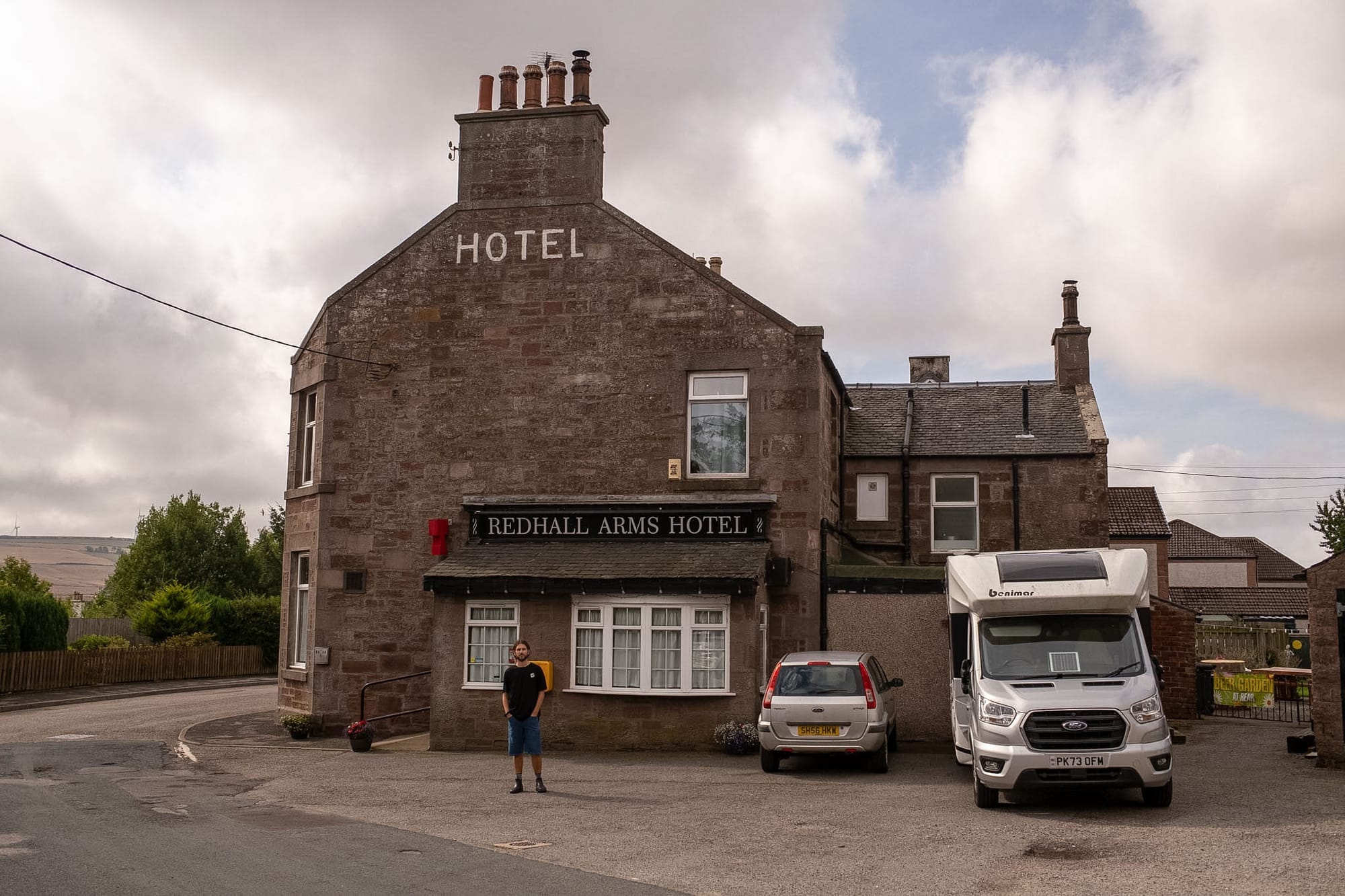
Business is a term very loosely used in Fordoun: on Saturday night, Grace and I finally mustered the energy and the courage to step into the local pub and face what I expected to be intense questioning or curiosity about the American and Kiwi couple who intrudes into this... place. Unfortunately, as we walked 20 steps from our front door, we saw that the Redhall Arms Hotel had closed. A quick view of their Facebook page soon revealed that this is quite normal: they close whenever nobody on the street wants a drink.
It only took a few moments before we arrived back at our front door, and before I knew it, I had walked to the shed, unlocked the padlock, and opened a trove of Peckish Complete Bird Energy Balls, peanuts, sunflower seeds, Bamford's Top Flight Feed, a plastic trough, one mug with a broken handle, and six hanging bird feeders.
And I began doing the unthinkable.
There I was, becoming someone I am not – or perhaps, becoming who I was always meant to be. Regardless, that is only the beginning, because what followed Saturday in Fordoun was Sunday in Fordoun, which is actually busier than any other day in Fordoun.
The British revere few things, and one of them is crumpets. If you have never heard of them, you must be, according to any decent British man, an ignoramus. To the Brit, crumpets are as important as the Falklands. To anyone else, they look like a toasted handheld pancake with holes – and that, here in Fordoun, was to be our breakfast. Because when in Rome . . . eat a crumpet loaded with butter and drizzled with delicious honey (Manuka honey, imported from New Zealand, because Jackie, whose home we are staying in, has great taste).
From breakfast, it was a 15 minute terror-filled drive down an assortment of 1.5 lane roads – where every quarter mile I was forced to remind myself of the Rental Man as a tractor which, racing to harvest before the incoming late-week autumn Scottish storm, dared me to end my life. Soon, arrival in Inverbervie brought peace – as my wife and I arrived at Bervie Presbyterian for a Sunday service.
There is a lot to the story of Bervie Presbyterian, which first started in 1618. But for now, the church is about twenty thousand years old, the minister is half the average age of the congregation, and the only children were his own. Parts of the worship were recorded – as in, there was no one doing worship and we were all singing unbelievably off-tune to an audio track. And yet, this ancient church – stone not the only thing showing its age – brought me closer to God in an hour than any 500 attendee well-funded disco-pop church service back home ever has.
What is that?
In Scotland, it doesn't take long for the world to go dim. Either because the houses have no windows, or because the sky is grey, or because the sun has set. The three make a wicked mixture, which is perhaps why pubs exist: they have lights. But if a pub is only as great as its gravitational pull (I learned as much during our time in London), then the Redhall Arms might as well be the only light for miles, and Grace and I are two moths in search of warmth.
I am glad our courage persevered from our failed attempt the night before: on Sunday night, we finally made successful entry into the Redhall Arms. What we experienced as we walked through the three-car carpark, then as we faced an older man with a gray beard, and gray hair, and gray eyebrows staring at his rubber shoes, wearing a rubber overcoat, and smoking a cigarette, was, as we came face to face with the wooden door, engulfing.
It took about 15 seconds for the two men and one woman at the corner of the bar nearest the billiards table to nod at us suspiciously, and merely 15 seconds more for Nick to drop the heavy hitter, as he poured two very Scottish Tennent Lagers: 'You guys from around here?' I am sure he would've given us a pint of foam had we kept to ourselves, even if he and all the rest had already asked and answered the question for us the moment a new car drove onto this street four days ago: 'No.'
But the incredible thing about a pub is what it draws out: both in drawing out bodies from their domiciles and then in drawing out the people occupying the bodies. Returning to our tables, Grace and I were planning on continuing our deep descent into Harry Potter, but as we walked out of the door earlier, I quickly snagged Fitzroy MacLean's Scotland: A Concise History. I was hoping for a concise history of pre-Roman Scotland, as I had spent weeks trying to uncover about Britain, but it took me until page 3 to see: there's no history before Rome, because no one wrote anything down.
Fortunately, my disappointment was ushered away – what better use for a pub? – as Nick brought over our two pints of Tennents. With him, a card for the local Indian restaurant (after I asked if he had any food; I should've known better).
But even more interesting than tandoori is what Nick – the financier, bartender, and world traveler who bought the Redhall Arms four years ago – had to tell us about the hotel portion: it doesn't even exist. He just lives in one of the rooms. Another lady lives in the second. And the third and final room is there for 'emergencies,' which are limited to, as stated by our bartender: funerals.
Nick is, as with most everyone you come across in every place you've never heard of, a character. Because the same force that draws in a man like Nick or a woman like Jackie to the distant reaches of a rural Scottish village, also compels me to reach for a keychain which dangles by the back door. And it was that evening when I started to wonder just as much about him, as he surely wondered about me.
Wondering – that's about all you can do in a place like this, and I must do it more. We have another week or so here, and tomorrow morning, when I grab the keys and walk to the shed and reach for the feed, I am going to do the very thing I did this morning: nothing, really. I will have nothing tangible to show you for the moments I spend on the lawn to my left, and if you ask me for the greater purpose behind my actions I have none to give you. And neither does Fordoun.
By every modern measurements, I have wasted time and Fordoun has wasted space. But surrounded by both time and space that the world considers pointless, I have now found life. And that, I will not forget.
This dispatch (and everything else) stays free because a few people fund it. The Out There Club is how — $7/month, so the work keeps coming for everyone.
//
New here? The archive runs back a ways.
//
If you enjoyed this, or if it made you cry,
please consider forwarding it to a friend.
//
Far Out? It's what Kiwis say instead of cursing — covers the incredible and the terrible both, and tone tells you which. A dispatch from Bryce Campbell, most Wednesdays, sent from Charleston, or Wellington, or wherever else I am.
//