
Far Out
The future is personal.
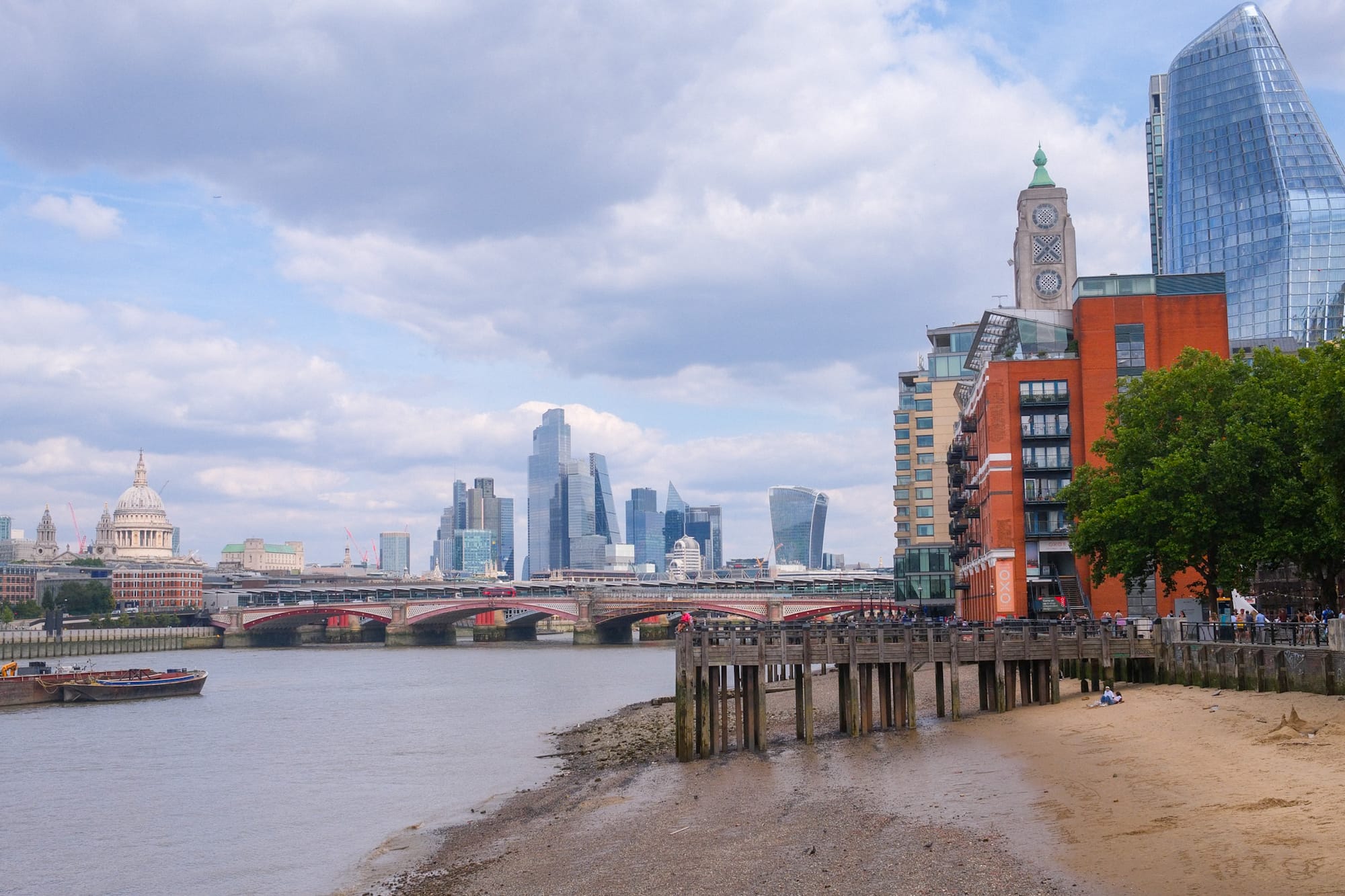
London is an overwhelming city. And in the center of London sits London Waterloo, which is an accompanying overwhelming train station. There is, on the ground floor, an assortment of trains, in addition to an array of grocery stores for all budgets and desires, a barber, a liquor store, and a number of escalators – which take you to the second floor, where you will find another incredible assortment of trains, all of which here are heading in one direction: southwest.
And southwest is where I was headed one scorching August afternoon. Onboard one particularly gray train, I sat in front of a small plastic table, which is all that separated me from my brother-in-law-in-law, Caleb.
On this day both of our wives were occupied and we were presented with an afternoon one often only dreams of: wandering between the plentiful museums found in that city.
But our time bonding together was soon coming to a close, and our wives, being sisters, had arranged a get-together that we were now en route to. Caleb was facing forwards, but I sat facing the rear of the train. It had only been moments since we had departed Waterloo when our conductor began seeking higher speeds. Not long after, London had begun to give way to trees and suburban homes.
Caleb is an easy man to verbally spar with, if only because his poignant questions are always shared from an unassuming facade – disguised primarily behind a slight smile and relaxed shoulders. Often it is only after they have settled just beyond my eardrum, that I have realized the actual depth of the topic he wishes to approach.
Facing forwards, then, it is no wonder that, as we sped past Vauxhall, and Battersea, and Clapham Junction in this tube which bends time, Caleb directed our conversation to the future.
And for some reason or another, though perhaps because of my presence online, a question was eventually posed to me: what does the future look like?
I spent a few seconds attempting to arrange my many thoughts, as the table between us wobbled back and forth, but they were exceedingly difficult to round up – and some had no words. Because that is a question I have thought an awful lot about, and not necessarily by choice.
I am in my sixth year of building a life – this life, whatever it even is – that continues to take many different forms. And I have been lucky enough, occasionally in distant regions and remote places, to speak to many different people from many different worlds.
Sometimes that is a young professional photographer in the outdoor adventure world, or it may be the man selling me a Honda Civic battery at the Napa in Nova Scotia. Other times it is the designer of a truck camper, the gentleman who picks me up as I hitchhike outside of Blenheim, New Zealand, or, as is most often the case nowadays, the wise and the gray, whose homes my wife and I have often found ourselves in during these recent travels, where we have been lucky enough to listen (rather than to speak) over a dinner of mashed potatoes and minced beef.
Oddly, I also seem to find myself in front of Germans. All across the world, I find them. We speak as I help them replace their blown tire on a rental F150 near Canada's Northwest Territories, or we share a breakfast of black pudding (it's blood), eggs, and toast in the Outer Hebrides, at a tiny bed and breakfast.
Through all of these conversations, and over the many years and countless interactions elsewhere in person and across social media and, more recently, these letters, I have come to think a lot about Egg McMuffins.
Today, we are told that we are in the middle of a revolution – an AI revolution. And revolutions, as those most heavily invested in them always encourage you to believe, are sure to bring about a revolutionary (and better) future.
Those forcing us into this new realm have already succeeded in some part: I use AI quite extensively, to be honest with you. I first designed my website six years ago by hand, over the course of many, many weeks. Earlier this year, I thought of something better, described it in sentences, and had it coded entirely in Claude and Grok. Then, I moved my website from its old platform to one I only found as a result of utilizing AI search results.
And when someone first enters their email on a form on my new website to receive this very newsletter, there is an extensive backend process – a maze in the cloud that, even with the help of AI, has taken me months to navigate and organize.
In effect, the only reason I am able to share my writing at all, and push it to the world, is because of the infrastructure built by a glorified chatbot that costs $12/mo.
I am very grateful for that. (Un)fortunately, the revolutionary claims repeatedly shouted by those shilling these chatbots always seems to fall flat. The technology is heavily limited, and it primarily prefers to weave and bob around anything you actually want it to do. I am, simply put, unsold by the notion that AI is going to take over many jobs. But it will certainly alter them.
Very few people attempt to use AI to change their world. Mere years after the initial craze, I often find it relegated by the many people I come across to, effectively, a search engine that better understands sentences than keywords. Sitting at lunch, how often does a conversation veer into the most obscure arena imaginable, only for someone to whip out a phone and share an answer to the most absurd question no search engine could ever fathom providing an answer for?
To most, AI is not life changing. To a few, worryingly, it is a friend. But for us all, it simply predicts the next letter that is most likely to follow the previous one.
It is a lack of creativity, inherent in anything not created in the image of God, that is a blessing. Because if you are the artist, the writer, the creative, or the individual who once upon a time, many years ago, would have had to be funded by a nobleman, you are now in luck. And if you were instead the person whose field was gobbled nearly entirely by corporations as a result of the Industrial Revolution – I mean the farmer, the mechanic, the joiner – you too now sit on the brink of something beautiful.
But only if you care to take a closer look.
Because the future is not robots writing newsletters. They can't. And it is not robots raising or butchering cows. They can't. It is not even robots booking your accommodations: with a week in Iceland upcoming, I attempted to use AI to help find relevant accommodation for my group and our desires. Every time, I eventually resorted to manually checking online. And it was faster that way.
So the very apocalypse we are supposed to fear (which coincidentally also inflates the value of these companies) doesn't appear to be on the horizon. Every claim of 'AGI' leaves me wondering what the 'intelligence' is that we're talking about?
The future is, then, one of two things: taste and choice. 100 years ago, your great grandfather ate what was available on his land, or available locally. But at some point, things became more centralized: 25 years ago, you or your father very likely ate highly processed foods. They were cheaper, easier, and more readily available thanks to the invention of freezing and multitudes of marketing.
But if I look around me today, I see a world of choices, and most people live somewhere in-between these two. There are people, genuine living people out there, who choose to eat an Egg McMuffin every morning. There are also people who search for the lady that feeds her hens kitchen scraps each morning and choose to buy eggs from her to scramble and place on top of the sourdough loaf they baked.
The former is easy, but the latter is easier than ever before.
I have no doubt, unfortunately, that the vast majority of people will easily succumb to the empty, debased, depressingly miserable whims of a subpar life. That is the story of the Bible. But for those who wish for something more – to be fulfilled, to have connection, to have value, to do something worthwhile... the opportunity has never been greater.
The rancher who was nearly drawn into extinction by massive corporate farms can now sell directly to someone 4 states across with grass fed steaks – of higher quality than any local supermarket – arriving on dry ice to someones front door, and, per dollar, the buyer receives more food, of a better quality, than they ever would at McDonalds or sometimes even Walmart.
The artist or writer who once had to pitch their worth to a wealthy nobleman, or more recently was bound to the creative fields corporations may have hired for, can today launch a website in minutes, and, if they are anything like me, spend six years (writing millions of words) before finding some small success and worth in a small slice of a likeminded internet. And at the end, they may very well achieve more freedom than either of the artists that came before. (I'll report back on this in a few more years.)
It was a conversation between me and another human being on a train, between London Waterloo and Wandsworth, that brought about these thoughts. It was in the depth of human connection – here specifically, a result of the modern age interestingly enough – that I found something worthwhile. And it was in the speeding across the outskirts of a city that the two of us found the quiet moment to contemplate such subjects.
The future will offer empty opinion, deranged thought, soulless 'art', and intention that is mass or corporately produced. At the very same time, the future will make readily accessible the carefully crafted, the lovingly built, the intentionally made, and the hard earned.
That is the story of the world we are in: those who desire noise, will find plentiful amounts. They have been able to for years. Those who love stagnation will find plenty of comfort. And those who desire slop, will get their fill – and an Egg McMuffin.
But those who aspire for something more, those who desire human connection, and to be understood, and to understand, and to admire the beautiful, and to be intentional, and to work harder at something not merely because it is the human way but because it is the better way, will find a future worth entertaining. On your way to that future, you will find those who you want to surround yourself with: the very people who will seek their 'eggs' from the lady who feeds her hens each morning.
That is the future I envision. That is the hope I have. And that is the world I am building my brand and business for. The things I do are done so with the understanding that tomorrow actually provides opportunity – for those who will pursue it. The places I go are chosen no longer chosen because the landscapes make for more viral videos, but instead because – like I have just found in the Outer Hebrides of Scotland – they hold authentic people and their authentic lives. Likewise, the things I write are written with the understanding that most people simply will not read them. But am I writing to the majority, or am I writing to me and you?
The fact that most people are never going to care about the same things as me, by conventional thought, should mean that the things I value in life are to be drowned out in a mass of white noise. But I have found just the opposite happens. The more I lean into what makes me human, the more I experience the human side of the world. All I have to do is bear the initial cost of putting myself out there.
Thankfully, this dichotomy has never been less of a competition. I will continue to create things of depth, and pursue and consume things of depth in my personal life, as I hope you do. Others may not choose the same, and that's alright. I am still going to enjoy my local eggs on my crafted sourdough – not to spite the fact that someone, somewhere is eating an Egg McMuffin, but rather because it is the same world that enables us both to choose our meal.
This project stays free because a few people believe it's worth supporting. The Out There Club is how — $7 a month.
//
New here? I send one of these (almost) every week, for free. Read more at the archive or subscribe here.
//
If this was worth your time, forward it to a friend.
//
Far Out — it's what Kiwis say instead of cursing — covers the good and the bad. Tone almost always tells you which.
//
A weekly dispatch from Bryce Campbell.